

Here we go into the details on the benefits of why data is so important to making decisions. We also dive into how to spot organisational data issues and the strategies you can put in place to fix them.
What does a good grasp of your data look like?
Data.
Data governance, data trust, data bottlenecks, data chaos, data value. Organisations’ understanding of data tends to be a mix of buzzwords. Still, at the end of the day, data is only as valuable as the decisions it enables.
If data isn’t being created, you can’t make something from nothing.
If your data is not available, people can’t access the ingredients to make decisions.
If your data is inaccurate, people won’t trust it to make decisions. Moreso, if your data is - god forbid - wrong, people will use it to make bad decisions.
But having accurate, available and correct data is only half the story. The other half sits with the people that use it - whether that’s your front-line workers using it to go about their day-to-day work or the CxOs making critical strategic business decisions.
Having a grasp of your data means that you should be able to stoically agree that your organisational data covers all of the above. You should also confirm that everybody within your organisation can confidently exclaim that they are well equipped to make data-driven decisions.
Now that we’ve covered that - let’s cover why all of the above is important.

Some on-the-ground applications of data
Data can be used to improve user experience. eBay uses data-fuelled AI to help buyers sift through 1.1 billion items in their catalogue by remembering what exactly they searched for previously. In the case of t-shirts - size and brand preferences too.
Data can help you make your product tailored to individuals. Whoever said, “try to please everyone, and you please no one” clearly never worked with recommendation engines. For example, streaming platforms such as Netflix predict what films to recommend to you based on past viewership and interests to give users a seamless experience and ensure they continue to subscribe to their services.
Data can help you get the drop on the competition. I’d be hard-pressed to find competition more cut-jugular than in the retail space, where margins are sheet-thin, and goods have to be moved at a break-neck pace. Tesco rose to the challenge with data collected through initiatives such as the Clubcard scheme. After the loyalty card’s trial, Chief Executive Ian McLaurin said, “I know more about my customers in three months than I did in thirty years”. Through targeted advertising and a greater understanding of what would be in demand when Tesco became the UK’s dominant supermarket.
Data can help you develop ground-smashing products and ideas. Covid-19 vaccine developers used data to guarantee the vaccine was safe by monitoring side effects, ensuring diversity among trial participants, and ensuring vaccines were distributed to the right places in the right quantities.
Data can help you investigate the bigger picture. Dow Jones uses data to explain the impact of events such as natural disasters on the world of business, using GCP both as their database and for their visualisation needs.
Data can help you keep your employees motivated. Google is known for many things. One of the biggest is their staff perks. From their 22nd-century office facilities to ones we’d be more likely to encounter ourselves, such as generous salaries and extended maternity leave. Performance reports and employee surveys were crucial for understanding what would work best for Google’s staff, especially in areas where personalisation was less of a possibility.
Data can help you build a more sustainable business. Carrefour used theirs to better understand customers’ buying habits and optimise their supply chain, with the ultimate goal of reducing food waste. Using Bigquery for their storage, with Google Cloud Platform being the greenest cloud provider, a double-win!
“Data is the new oil.”
We know that data is essential to making decisions. It’s important to note, though, that just ‘having’ data will lead you nowhere. Oil sitting in a barrel is about as useful as a chocolate teapot. Like oil powers engines, data needs to power your organisational engines.
Your sales engine should be well-powered; how else will your sales reps know who to target? Your marketing engine should be powered by data, too; being able to segment audiences based on whatever criteria you dream up is a tremendous power to behold. But it’s not only ‘marketing’ and ‘sales’ - those are the easy fish to fry with data. If you’re a construction company, it’s in your best interest to let your building staff know exactly what they’re building and where. If you’re a law firm, having a record of every law in your area of expertise is immensely valuable, reducing the research time needed by your solicitors.

Feed your engines!
The crux of it all is that organisations often consider their departments as engines that need to be fed with ‘data’. Sales, marketing, customer success, delivery, the list goes on. In reality, every worker in your organisation is a little engine that requires data to make decisions. The more you fuel those tiny engines, the more output you’ll see. This leads us to our first point. Data availability.
I’d like to preface this by saying that it’s equally as important to build the culture as it is to build the technology. Building a data tech stack first, then involving the people, is a disaster waiting to occur. Data culture and data technology are multiplication, not addition. 1 x 0 = 0. You can’t win without both.
The three things to get right
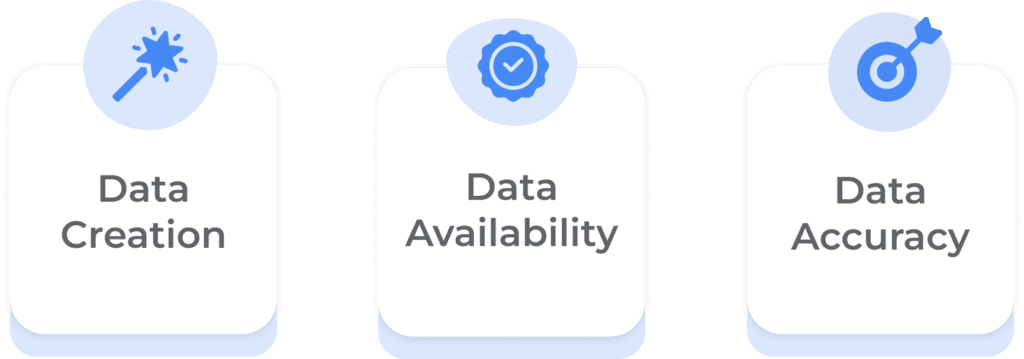
Data creation
First of all, you have to ensure that data is being collected and stored.
Without data, you can’t measure the impact of your decisions. Imagine being on a ship, trying to correct your course without radar, GPS or a map, while blindfolded - that’s making business decisions without data.
Signs you have data creation problems look something like this:
“Are we tracking that?”
“Are we keeping records of that?”
“Since when have we been aware of this problem?”
“Have we a scooby what’s going on here?”
With how cheap storage costs are nowadays (GCP, AWS, Azure - for comparison), you have no excuse to not be storing the data you’re generating. You're putting yourself at a competitive disadvantage if there is no organisation-wide plan to create and store as many data points as possible.
Some notes on data quality
As well to creation, it’s crucial to be storing quality data. This means applying quality management techniques to ensure the data is fit to serve your organisation's specific needs. There are six metrics to measure data quality, as referenced by heavy.ai.
Accuracy: The data should reflect actual, real-world scenarios; the measure of accuracy can be confirmed with a verifiable source.
Completeness: Completeness is a measure of the data’s ability to effectively deliver all the required available values.
Consistency: Data consistency refers to the uniformity of data as it moves across networks and applications. The same data values stored in different locations should not conflict.
Timeliness: Timely data is data that is available when it is required. Data may be updated in real-time to ensure that it is readily available and accessible.
Uniqueness: Uniqueness ensures no duplications or overlapping of values across all data sets. Data cleansing and deduplication can help remedy a low uniqueness score.
Validity: Data should be collected according to defined business rules and parameters, conform to the right format and fall within the right ranges.
Without data quality, it’s like navigating the sea with a map made in the 1700s. Or a GPS module that decides to pack it in for 3 hours a day. In other words, it is possible but comes with a greater possibility of failure and a wider range of headaches, especially when better tools are so widely available nowadays.
Note that you can start your data collection by collecting everything and storing it in a data lake. Still, you have to be wary of it turning into a swamp. We’ll focus on what policies and tools you can deploy to circumvent that.
Data collection is important because although you may not need the data now, the beauty in data is that it can be retroactively analysed. Analysts three years in the future can use your trends from now to derive insights and action plans.
So what can you do? If there is no data plan, your immediate data plan must be to start collecting data. Immediately. If you’re using SAAS platforms for your workflows, such as Hubspot or Google Analytics, chances are they’re already generating data; you just need to make it available.
Data availability
‘Data availability’ is whether the data you’ve admirably been collecting is accessible to the right people. There are three parts to the data availability formula. “Do the right people have the right access to the right data?”.
Data availability is super important because if the right people don’t have access to the right data, you are not maximising the value that the data can generate. What use is having metrics on the ‘average leads generated’ if you don’t have anyone to make any decisions because of it?
It’s not only about the access part, either; it’s also essential that anyone can query the data, which means everyone should have the appropriate skills to do that. (Looker makes that trivial!). Having a data department that everyone goes through to get information is not only highly inefficient but also dull and boring for everyone involved. Your data analysts want to go into deep dives and explore your datasets to create insights that generate value, not re-generate Mary’s monthly Finance report for the team’s monthly catchup. Mary should be able to do that herself. And if she can’t, that’s a problem.
For 80% of data questions, your employees should be able to answer them themselves. Leave your skilled analysts to answer the 20% difficult, valuable questions.
Symptoms of having low data availability may look like this:
“Where is that metric?”
“I’m waiting for Steve to get the report back to me.”
“We cannot commit to this, as we don’t have the data to support it yet.”
“I can’t go in deep into this because the data team is at capacity.”
If your data team is running like a helpdesk and not a research and development department, you’re in dangerous waters. It’s time to reflect on the culture and technology you use to drive more value out of your team.
Suppose you feel like you don’t have high data availability within your organisation. In that case, it may be time to reflect on how your organisation uses data. It’s time to audit your culture and technology and create a roadmap to democratise your data. You can use our project guide as a framework for success.
Data accuracy
Data accuracy is simply whether or not the values you present are correct and consistent. Often, in organisations, there’s a discrepancy between two departments reporting on the same metric, supposedly using the same data, yet coming to two completely different conclusions. This problem scales more as the company grows; your departments become more dispersed - especially if you set up shop in an entirely different country. You begin to scale. More and more software gets bought, and more software gets ‘sunset’. On your quarterly business reviews, sales and marketing start to quarrel due to a misunderstanding of what the ‘target demographic’ metric was.
This is important because organisations need a consistent and reliable picture of what’s going on. The less consistent and less reliable this picture gets, the less trustworthy the data becomes. And once your employees start to lose trust in the data, well, you would actually probably be better off with no data at all.
Some things to watch out for:
“Are you sure that’s what that metric means?”
“I have no idea where that number came from.”
“I'm sure that number was different when I last looked at it.”
“Are you sure that’s what the number is? I saw it completely differently.”
To solve this problem, you need to establish a company-wide data dictionary. Note down your most important metrics to track, and loop in every department with any stake in that data. This should be made simple if your data tech stack is up to scratch.
This is more or less Looker’s secret sauce. Looker allows you to create this dictionary and for everyone that uses the data to be aligned with exactly what it means. No more quarrels over dashboards and metrics.
Conclusion
It’s pivotal for you to ensure that you have consistent and accurate data available to everyone who needs it so that they can make the most informed decisions they can. Any discrepancies, unavailabilities, or inaccessibility issues can throw a spanner into the works and make your end users resent using any data you give them.
At Cobry, we believe that the best data technologies are modern, scalable and usable; and there’s no better platform for this than Looker with Google’s BigQuery. We have a whole article on why we believe that Looker and BigQuery are no brainers for modern businesses. Still, we’d also be more than happy to talk to you one-to-one about why we think that. ?
Drop your email, and we’ll get back to you asap.